Federal Employee and Retiree Trends Show Increased Tax Noncompliance
Why did we do this review?In 1993, the IRS established the Federal Employee/Retiree Delinquency Initiative (FERDI) program to promote federal tax compliance among current and retired federal civilian and military employees. This review is a follow-up to a prior audit and evaluates the IRS’s efforts to address federal employees who fail to file their tax returns or fail to pay their balance dues. What did we find?IRS data shows that the overall balance owed by federal employees and retirees increased by more than $1.5 billion (32 percent) between FY 2021 and FY 2024. This was partly because certain collection programs were suspended during the pandemic. The IRS resumed one of these collection programs and anticipates that the delinquency rates will decrease. 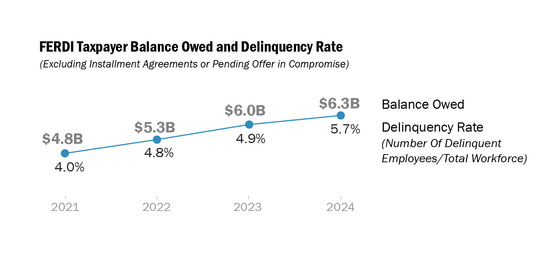 Delinquency rates among employees are partially dependent on whether agencies can hold employees accountable for their lack of tax compliance. Due to privacy restrictions, the IRS cannot share specific employee related tax information with the delinquent employee’s federal agency. However, the Department of the Treasury is permitted to hold its employees accountable, and accordingly, the delinquency rate is 2.4 percent. We also found that approximately 50,000 federal civilian employees failed to file a tax return for multiple years. As part of this review, we identified 122 taxpayers with 8 or more unfiled returns. We referred these taxpayers to Criminal Investigation for review because the IRS’s Collection function had not. In May 2025, the IRS collaborated with the Department of the Treasury to create a notice informing current and retired federal employees of noncompliance with their tax obligations. The IRS mailed 427,000 of these notices. The IRS stated that this was a one-time notice and does not anticipate using it again. The IRS should revisit our prior recommendation to coordinate with the Department of the Treasury Office of Tax Policy to consider a legislative proposal to amend Internal Revenue Code Section 6103 to allow the IRS to share essential return information with other federal agencies upon the IRS’s identification of a current federal employee who is tax delinquent.
For more information:
Incident and Service Ticket Management Needs Improvement
Why did we do this review?An incident is an unplanned interruption to, or a reduction in the quality of, an information technology service. When an incident occurs, it is important to resolve it effectively and timely to minimize the level of disruption to the IRS. What did we find?We found that many incident tickets were unnecessary and not timely resolved. As a result, IRS employees spent time reviewing and closing the unnecessary incident tickets instead of reviewing and resolving legitimate incidents. A significant number of incident tickets were unnecessarily generated because procedures were not followed. Specifically, nearly 20,000 of 22,600 (88 percent) of the highest priority incidents tickets (IRS refers to these as Priority 1 and 2) generated from April 2023 through September 2024 were automatically generated by a process that should have been disabled. In addition, incident ticket resolution times exceed the IRS’s target time frames. Our review of approximately 2,640 Priority 1 and Priority 2 tickets found that nearly 1,240 (47 percent) of the tickets were not resolved timely. One of the Priority 1 incidents we identified affected the Modernized Electronic Filing system. This delay impacted the system’s ability to generate timely confirmations to taxpayers that the IRS received the tax return for processing at the beginning of the 2024 Filing Season for more than two weeks. Further, approximately 4,600 tickets (of all priority levels) created between May 2023 and August 2025 were still unresolved as of August 2025. The age range of the unresolved tickets was between 4 and 572 days old, which is beyond required time frames.
For more information:
Having trouble viewing this email? View it as a Web page.
|






No comments:
Post a Comment