The IRS receives trillions of dollars in federal tax revenue annually via payments from people and businesses. But what happens when a payment has incomplete or missing information? Our latest report looked into the process.
IRS Programs That Resolve Billions of Dollars in Unidentified Taxpayer Payments Need to Be Improved and Modernized
Why did we do this audit?Missing or incomplete payment information (e.g., the check or money order does not include the taxpayer’s name, identification number, form type, or tax period) can impact the IRS’s ability to apply payments to the correct taxpayer account. What did we find?From Fiscal Years 2022 through 2024, the IRS received approximately $3.2 billion in unidentified payments and successfully applied $2.3 billion (70 percent) to taxpayer accounts. In addition, $741 million (23 percent) in unidentified payments were closed from the Unidentified Remittance File. These payments were transferred to the Excess Collection account (i.e., the payment was still unresolved one year after receipt) or removed from the unidentified payment inventory. Payments are removed from inventory when the checks are dishonored or voided (e.g., insufficient funds in the bank account and returned as unpaid from a financial institution). The IRS could not resolve the remaining $218 million (7 percent) of these payments
and carried them over as ending inventory. 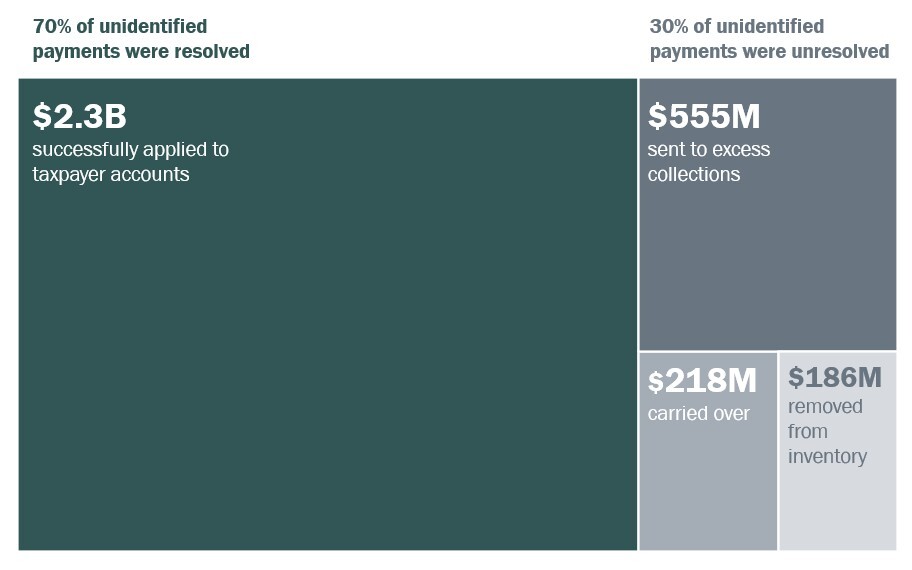 The IRS also does not distribute the inventory of work at its Tax Processing Centers based on available resources. For example, the Unidentified Remittance unit in the Ogden, Utah, Tax Processing Center had the same number of staff as the Kansas City, Missouri, Tax Processing Center. However, Ogden accounted for 40 percent of unidentified payment inventory compared to 11 percent in Kansas City.
Having trouble viewing this email? View it as a Web page.
|






No comments:
Post a Comment